Clown is something you can study — historically, physically, theatrically, socially and by doing it in front of actual people.
I offer individualized study for emerging clowns, performers, facilitators and curious humans who want to develop their own practice rather than imitate mine. Study can combine conversation, assignments, reading and viewing, character development, practical experiments, field experience and reflection.
Format
What it is
Starting point
Clown Consultation
One focused 60-minute session: character, act, practice, problem or next steps
$75
Short Study
3 sessions with exercises/resources between meetings
$200–250
Intensive
Bespoke 2–3 day immersion, potentially including fieldwork/performance observation
from $500
Independent Study / Mentorship
Roughly 10 weeks; individualized curriculum, regular meetings, assignments, practical work and culminating reflection/project
from $1,000
Remote Clown Mentorship, Classes & Intensives
You don’t need to live in Portland (or enroll in clown school) to study clowning with Jusby. Remote sessions are available for emerging clowns, working performers, curious beginners, and artists developing a particular character, act, or practice.
Individual Mentorship One-on-one video sessions built around what you’re actually working on: finding your clown voice, character development, audience relationship, props and gags, improvisation, performance structure, ritual, or the practical business of being a working clown.
Remote Workshops & Group Classes Standalone Zoom classes for clown groups, festivals, communities and curious humans. Available as one-off workshops or short series.
Clown College: Watch a Class
Finding Your Voice / Welcome to Clown College What makes your clown yours? Jusby introduces clown as a practice of presence, vulnerability, play and discovering what already works through you.
Gags & Props Objects become partners rather than accessories. A practical look at discovering play, extending a gag, following accidents and letting props suggest performance.
Clownfest / Learning Through the Clown Community What happens when clown education leaves the classroom: festivals, other performers, traditions, experiments, failure, observation and participation.
These aren’t polished online courses. They’re excerpts from live, participatory clown education because clown is learned by doing it with other people.
Internships & Extended Study
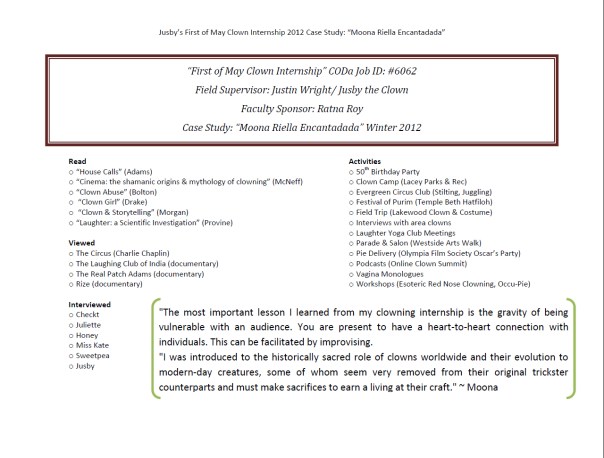
A “First of May” internship can be written with formal academic requirements or pursued more informally. Each educational experience is custom designed for the needs of the emergent clown. Jusby has relevant reading and viewing materials for students at every level from the unschooled to the doctorate. Academic credit may be possible. Students seeking college credit are responsible for arranging approval through their institution; I can collaborate on learning objectives, readings, activities and documentation.
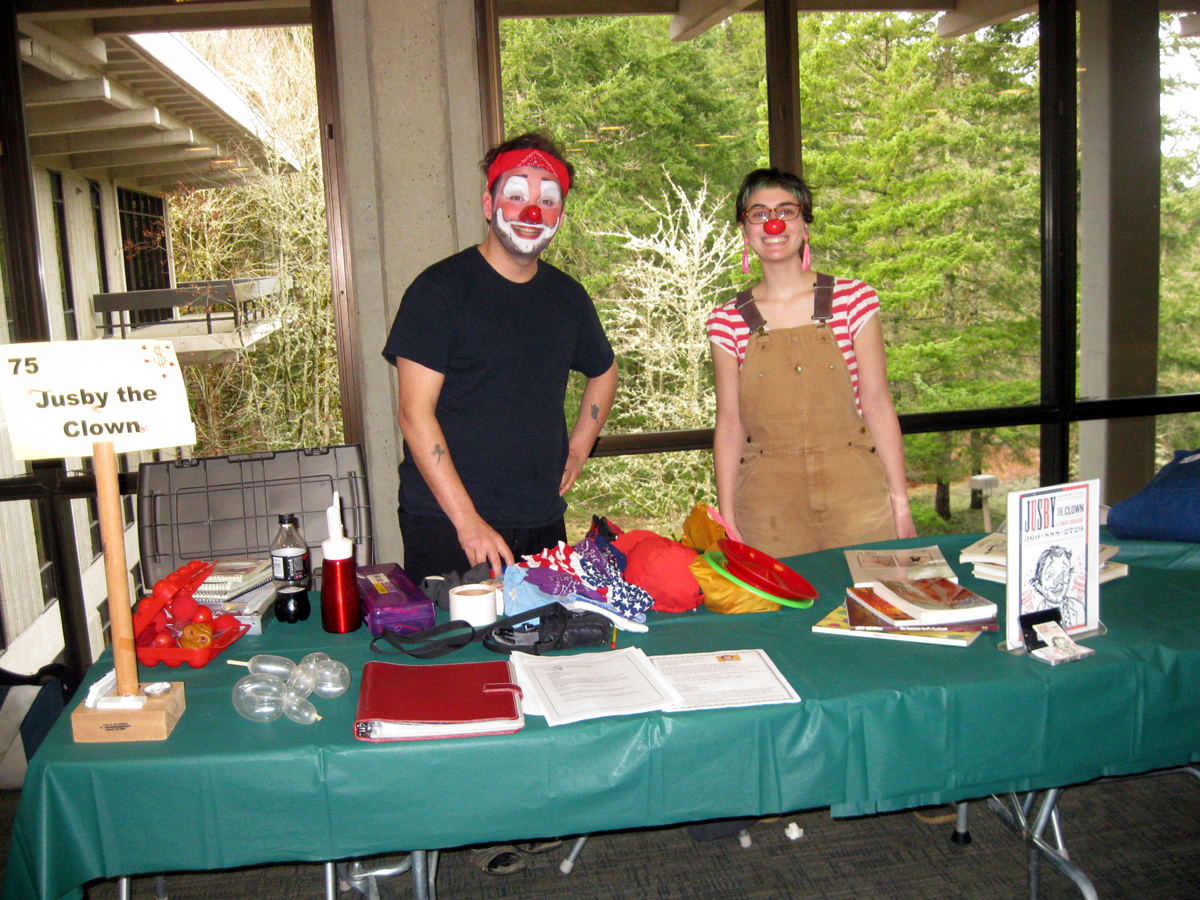
Jusby and Moona at the Internship Fair
“The most important lesson I learned from my clowning internship is the gravity of being vulnerable with an audience. You are present to have a heart-to-heart connection with individuals. This can be facilitated by improvising.
“I was introduced to the historically sacred role of clowns worldwide and their evolution to modern-day creatures, some of whom seem very removed from their original trickster counterparts and must make sacrifices to earn a living at their craft.” ~ Moona
Heather “Honey” – an anthroposophical puppeteer and mental health professional [mentee]
I got my start as a clown with Jusby as a result of a series of synchronicities. Something he is really good at is being there for the moment and allowing things to evolve, with some suggestions on what might work in any given situation. He introduced me to other clowns and the community of care that surrounds them. The world of clowns and clowning is a multifaceted place. There are clown alleys, and mentors and classes with people who have done pro training in the circus arts. But sometimes you need someone to witness what is coming out and be in a spirit of play with what is. And Jusby is great with that and with learning from experience. After becoming a clown, I worked in mental health with a psychologist who had worked as a pro clown with the Big Apple circus before his career in psychology. Becoming a clown allowed me to be present for a lot of different situations in that setting and to have a spirit of play, curiosity and resilience for the work. I was able to improvise from there into another character, an uptight bookkeeper who was keeping somewhat of a three ring circus afloat. In New York I’ve found some interesting roles in some independent films and performance art projects, and I have been part of producing a well known local community festival.. Clowning got the ball rolling on a number of levels. Grateful for that! Thanks, Jusby!
Heather ‘Honey” Duke
Heather and Jusby met both as students of Dawn Nilo, a Red Nose educator of anthroposophical Clown.
Jusby introduced her to the Red Nose Brigade and the world of parades, parties, and Pies.
Gemma “Chrysalis” – a vegan Unitarian Universalist minister [5 day Meadville Lombard Theological School internship visit from IL]
Miranda “Pinecone” – a rural Texas mime and clown with live animal interaction [phone and text mentee]
“No limit to how much strength as a real performer one can acquire from connecting with Jusby.”
Sonny “Oscar de Vile” – NB immigrant drag artist [mentee]
Essay: Why I Want to Be a Clown: As someone who was mute as a child, I’ve always loved squeezing characters and expressions out of me, I was the kid who didn’t talk but was still annoying and over-expressive. I’ve always loved performing but would get discouraged and burnt out when my parents would see me as an asset and I often gave up, feeling defeated and unmotivated; that is, until I started theatre at the end of high school, and drag at twenty-one, art forms that weren’t considered respectable to the model minority myth my parents were trying to uphold.
Ever since I got back into performing, I was drawn to the more spontaneous and childlike parts of it. At first, I just thought I wanted to be a children’s entertainer as a drag artist, but I also wanted to branch out more and couldn’t figure out what my actual goal was. Then, I finally realized, clowns kept showing up in my life, everywhere, every part of my journey as a reclaimed artist and as an independent young adult. So, I decided to make a promise to myself to start clowning and as soon as I moved to Portland from the east coast.
Since I was mute in childhood, I want to be a silent clown and use excessive expressions and physical comedy; I think it will feel cathartic to be a silent entertainer again as an adult.
What can we study?
Clown identity & character · improvisation · audience relationship · vulnerability & failure · sacred clown/trickster traditions · physicality · props & gags · puppetry · facilitation · laughter · consent · devising performance · street/roving work · the business of being a working clown
Every course of study is different. We start with what you are already making, what fascinates you, and where you want to go.